
Why Imposter Syndrome Is Only Part of the Story for Culturally Diverse Leaders
Quick answer: Imposter syndrome in culturally diverse leaders is often mislabelled as a personal flaw when it is frequently a rational response to structural conditions: a higher bar for proving competence, less grace for mistakes, and repeated microaggressions that question their capability. Research from Diversity Council Australia, the Australian Human Rights Commission and the Center for WorkLife Law shows culturally diverse leaders face double standards their majority-culture peers rarely encounter. The fix starts with naming the structural cause, then pairing that awareness with sponsors, documented evidence of impact, and organisational changes to how merit is judged.
© Potential Q 2026. All rights reserved. This article may be shared with attribution to Potential Q and a link back to this page.
Suggested citation: Potential Q. (2026, July 18). Why do culturally diverse leaders experience imposter syndrome differently? potentialq.com.
What Is Imposter Syndrome, and Why Doesn't the Standard Explanation Fit Culturally Diverse Leaders?
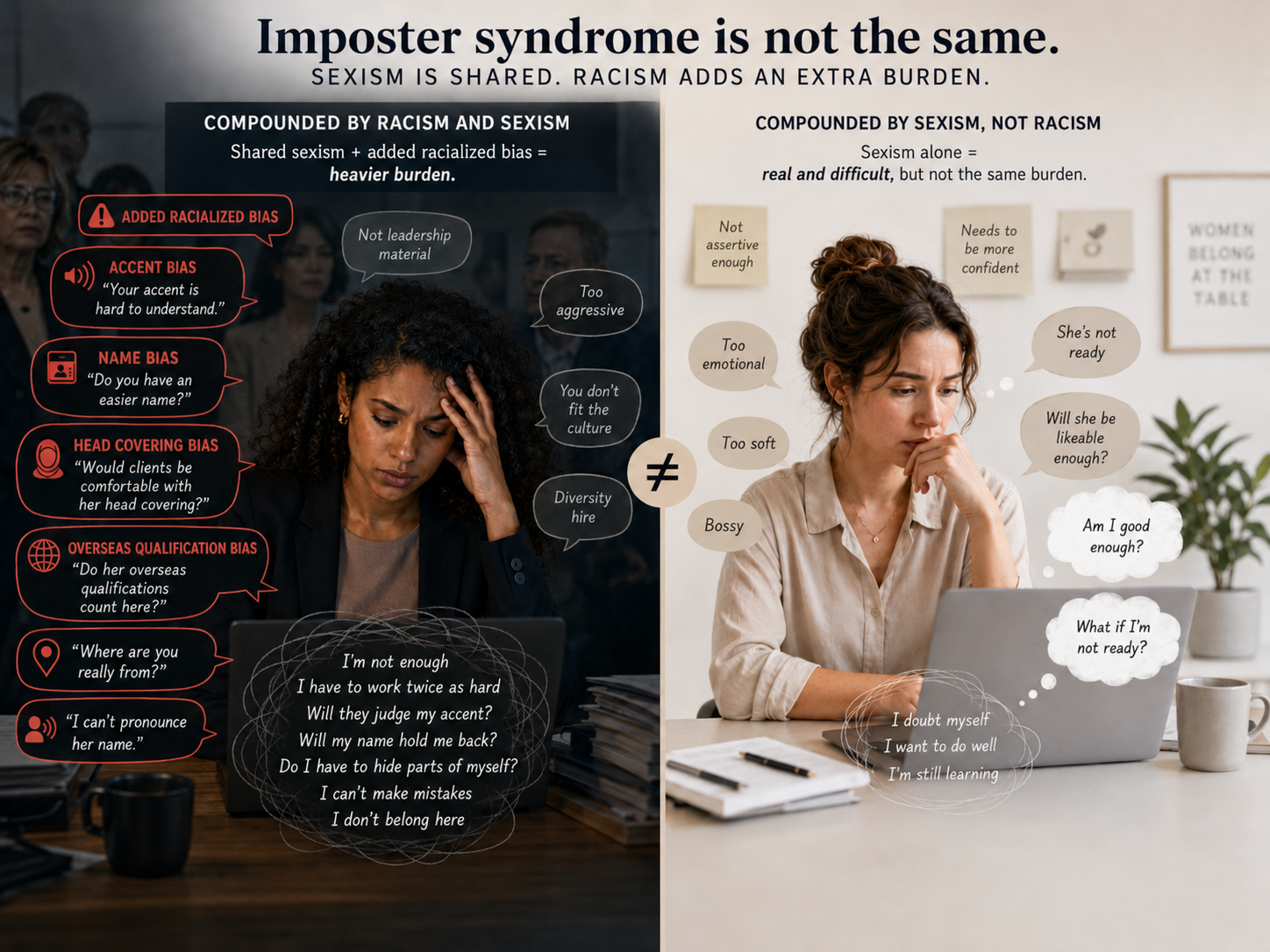
Imposter syndrome describes the persistent feeling that your success is undeserved or about to be exposed as luck. The standard model treats it as an internal thought pattern to be corrected with confidence-building. That model misses something important for culturally diverse leaders. A 2024 review in the Annual Review of Clinical Psychology on impostor phenomenon in racially and ethnically minoritized groups found that self-doubt in these groups is closely tied to actual, ongoing experiences of discrimination, not just an internal cognitive distortion. Greater exposure to discrimination predicted higher impostor feelings, and the review called for interventions that address the environment, not only the individual's mindset.
For a culturally diverse leader, the feeling of being a fraud is frequently a correct reading of an unequal environment, not a distorted one. That distinction matters, because it changes the fix: you don't out-think a structural problem with more confidence.
Why Is the Performance Bar Higher for Culturally Diverse Leaders?
Decades of workplace bias research describe what the Center for WorkLife Law calls “prove-it-again” bias: groups stereotyped as less competent, including women and people of colour, are judged on demonstrated performance while others are judged on potential. About half of women and people of colour report having to prove themselves over and over to get the same respect colleagues receive automatically, compared with roughly a quarter of white men. Mistakes within these groups are also remembered longer and held against them more heavily.
Diversity Council Australia's research on culturally diverse women leaders found the same pattern in practice. Although 88% of culturally diverse women surveyed planned to advance to a senior role, only 10% strongly agreed their leadership traits were recognised or their opinions valued. One in four had already scaled back their ambitions because of cultural barriers at work, according to DCA's Cracking the Glass-Cultural Ceiling report.
How Do Microaggressions Chip Away at Confidence?
Comments like “your English is very good for a …” or “wow, I’m surprised you have been appointed” are not compliments. Researchers classify them as competence microaggressions: brief exchanges that question a person's intelligence, credentials or belonging based on race or origin. A Harvard Business Review study by Stanford researcher Malissa Alinor found that competency microaggressions directed at Black professionals measurably changed how colleagues perceived their competence afterward, and how those professionals then behaved in team settings. The damage isn't only personal; it reshapes how a team works together (see HBR, 2022).
The same double standard shows up around mistakes. Under prove-it-again bias, an error by someone in a racially and culturally marginalised group is remembered and held against them, while the same error from someone in the reference group is waved off (“he's new,” “she's just having an off week”). Repeated over years, this is what turns one mistake into ‘I don't belong here.’
Why Doesn't Mentorship Always Help?
Mentorship is often the default fix organisations reach for, but it has limits. A 2025 study in the Australian Journal of Social Issues on racially and culturally minoritised academics in Australian universities (Gatwiri, Krupka & Kim) found mentoring mattered, but participants drew a sharp line between mentors, who offer advice, and sponsors, who use their own credibility and influence to advocate for someone's advancement. The RISE Project: An Insights Report, DCA/SSI/CEW, makes the same distinction: a mentor helps you find the door; a sponsor opens it.
There's also a mismatch in lived experience. A mentor who says “I've felt like an imposter too” may mean it sincerely, but if their version of self-doubt was never compounded by racism, sexism, or having their credentials repeatedly questioned, the comparison can minimise rather than validate what a culturally diverse leader is navigating. Impostor phenomenon research is explicit on this point: the same label can describe two structurally different experiences, one rooted in general self-doubt and one rooted in real, repeated discrimination.
What Can Culturally Diverse Leaders Do When They Start Questioning Themselves?
Name the structural cause before the personal one. When self-doubt spikes after a specific incident, a passed-over promotion, a dismissive comment, ask whether it matches a documented bias pattern rather than defaulting to “maybe I'm not good enough.” This reframing is what the research recommends over generic confidence-building.
Seek sponsors, not only mentors. Look for someone senior who will advocate for you in rooms you're not in, not just someone who will listen. Sponsorship has a stronger link to promotion outcomes than mentorship alone.
Keep a record of your wins. Because mistakes are remembered longer for scrutinised groups, deliberately documenting outcomes, feedback and impact creates a counterweight to that memory bias, and gives you evidence to draw on when self-doubt creeps in.
Separate the feeling from the verdict. Self-doubt can coexist with genuine competence. Treat it as information about your environment worth investigating, not proof of inadequacy.
What Can Organisations Do to Fix the Structural Problem?
Individual coping strategies only go so far if the environment doesn't change. Diversity Council Australia's framework calls on organisations to disrupt bias in hiring and promotion decisions, formalise sponsorship rather than leaving it to chance, and “recraft” leadership models that quietly reward the assertiveness and self-promotion typical of Western leadership norms over other legitimate leadership styles. The Australian Human Rights Commission's Leading for Change report similarly recommends transparent, bias-checked promotion criteria and public reporting on representation at senior levels, because what gets measured is what tends to change.
Conclusion
The self-doubt is real. The cause usually isn't. A higher bar, less grace for mistakes, and constant competence-questioning are documented systemic patterns, not personal failings. So treat the feeling as a signal of a flawed system, not a personal indictment: find sponsors who'll advocate for you, keep a record of your wins, and lean on people who get the specific pressure you're under. Then advocate your organisation to fix its side: bias-checked promotions, real sponsorship, leadership models that don't reward one cultural style over every other. The goal isn't to out-hustle imposter syndrome. It's to reshape the environment that creates it.
Frequently Asked Questions
Is imposter syndrome the same experience for everyone?
No. Standard imposter syndrome research treats the feeling as an internal thought pattern. A 2024 Annual Review of Clinical Psychology study on impostor phenomenon in racially and ethnically minoritised groups found the feeling is closely linked to real, ongoing discrimination, meaning the cause, and the fix, differ from the general population.
What is the difference between a mentor and a sponsor?
A mentor gives advice and guidance. A sponsor uses their own influence and credibility to advocate for your advancement when you're not in the room. Culturally diverse leaders typically benefit from both, but sponsorship has the stronger link to promotion outcomes.
Is a comment like “your English is very good” actually a microaggression?
Yes. Researchers classify comments that question someone's intelligence, credentials or fluency based on their race or origin as competence microaggressions. Studies show they measurably affect how colleagues perceive competence afterward and how the recipient then engages with their team.
Why do my mistakes seem to be remembered longer than my colleagues'?
This reflects “prove-it-again” bias, documented across decades of workplace research: groups stereotyped as less competent are judged on performance and their errors are held against them, while others are judged on potential and their errors are quickly forgiven.
How common is this experience for culturally diverse leaders in Australia?
Diversity Council Australia surveyed culturally diverse women leaders and found that while 88% planned to advance to a senior role, only 10% felt their leadership traits were genuinely recognised, and a quarter had already scaled back their ambitions because of cultural barriers.
What should I do if my mentor says they've felt like an imposter too?
Acknowledge their intent, but recognise the comparison may not hold. Research distinguishes impostor feelings rooted in general self-doubt from impostor feelings compounded by racism or sexism; the second requires structural remedies, not just reassurance.
Sources
Alinor, M. (2022). Research: The Real-Time Impact of Microaggressions. Harvard Business Review.
