
What Is the Accent Hierarchy at Work, and How Do Leaders Disrupt It?
Quick answer
An accent hierarchy is the unspoken ranking of English accents in Australian workplaces, British, Australian, American and Canadian English are treated as the professional default, while accents linked to African, Asian and Latin American backgrounds can be wrongly read as less competent, less leader like. Research confirms that accent bias shapes hiring and employability judgements, even though accent has nothing to do with skill. Leaders disrupt it by immersing themselves in accent diversity, training decision-makers to notice the bias, and judging people on what they say rather than how they sound saying it.
Copyright and attribution: © 2026 Potential Q. This article may be shared with attribution to Potential Q and a link back to the original publication.
Suggested citation: Potential Q, “What Is the Accent Hierarchy at Work, and How Do Leaders Disrupt It?”, potentialq.com, 2026.
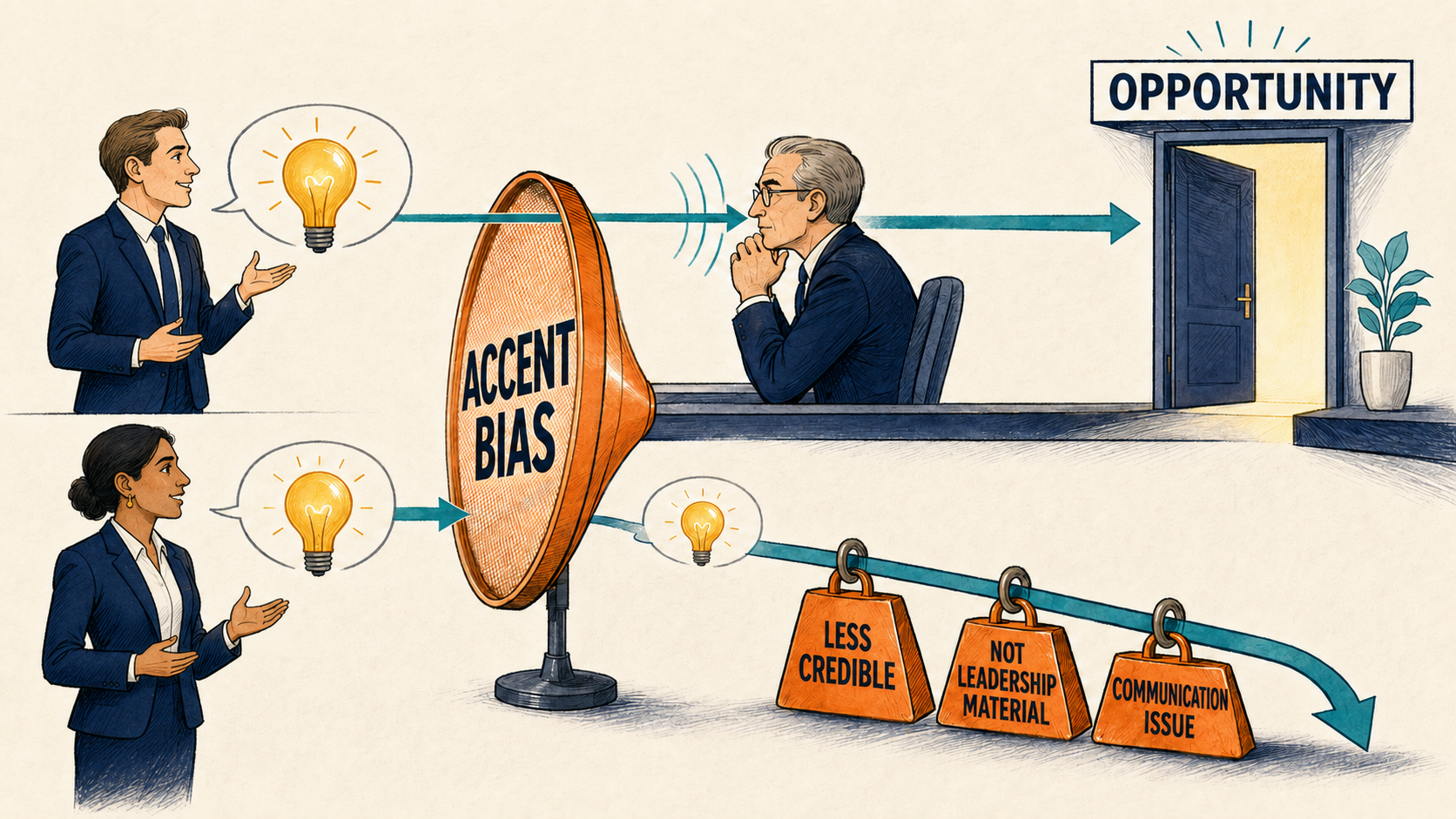
What Is an Accent Hierarchy in the Workplace?
An accent hierarchy is the social ranking of accents based on perceptions of legitimacy, credibility and belonging. Accents associated with dominant groups are often treated as more “standard” or professional, while others may be unfairly judged as less intelligent, capable or suitable for leadership. These rankings are socially constructed and vary across countries, cultures and workplaces.
In Australian workplaces, the dominant varieties of British, Australian, American and Canadian English sit at the top and are treated as neutral or “the norm,” while accents linked to African, Asian and Latin American communities can sit lower, often read as less competent regardless of the speaker's actual skill.
The hierarchy is not written down anywhere. It shows up in who gets interrupted less, whose ideas get credited, and who is picked to present to clients or steered away from leadership. A 2026 insights report from Diversity Council Australia (DCA), Settlement Services International (SSI) and Chief Executive Women (CEW) on culturally and racially marginalised (CARM) women found accent is one of several “invisible burdens” (alongside migration, race, gender, age, caregiving and visa history) participants carried into their careers, often without realising how much it shaped how they were perceived.
What Does the Research Say About Accent Bias in Hiring and Promotion?
Accent bias is driven by perceived social status, not by how understandable someone actually is. Research by Dr Jessica Spence and colleagues at the University of Queensland found no prejudice between two widely spoken native-English accents, such as American-accented English versus British-accented English. Bias only appeared when comparing one of these against what researchers termed a “foreign” accent, such as American-accented English versus Chinese-accented English. The hierarchy is about which accents are coded as belonging to the dominant cultural group, not which English sounds clearest.
Accent bias and gender bias compound, so culturally diverse women face a sharper penalty than culturally diverse men. Both the UQ meta-analysis and the ANU employability study found that accent affected women’s employment-related evaluations more strongly than men’s. The UQ meta-analysis found that women with accents classified as non-standard were judged less favourably than women with standard accents, while men were judged similarly regardless of accent. The studies included in the meta-analysis examined numerous accent varieties, including Mexican-, Chinese-, Indian- and Japanese-accented English. Similarly, the ANU study found that linguistic background significantly affected women’s employability ratings but not men’s, with Anglo women rated the most employable and Russian-speaking women the least employable. The UQ researchers concluded that women with non-standard accents may face stronger discrimination in job interviews than men with comparable accents.
The DCA, SSI and CEW RISE Project report, drawn from work with CARM women across 25 Australian organisations, found participants had “learned that speaking up could lead to being labelled ‘difficult’, ‘aggressive’ or ‘not a cultural fit’,” which over time taught many to stay quiet as self-protection. Mentors and coaches on the project also observed many participants presented with “deep self-doubt due to their experiences despite objective evidence of competence,” alongside carrying accent, race, gender and other burdens.
Is Accent Discrimination Illegal in Australia?
Accent itself is not named as a protected attribute, but discrimination connected to it is often unlawful. Under section 351 of the Fair Work Act 2009, employers cannot take adverse action against employees or applicants because of protected attributes, which include race, national extraction and social origin, according to the Fair Work Ombudsman. National extraction refers to a person's heritage, nationality or where they or their parents were born. If a decision not to hire or promote someone is really about their accent as a proxy for race or national origin, it can fall within these protections and within the Racial Discrimination Act 1975, administered by the Australian Human Rights Commission. In practice, accent bias is hard to pin down as a legal claim because it rarely gets stated outright. It tends to surface as vague feedback about “fit,” “presence” or “communication style.”
How Can Leaders Disrupt the Accent Hierarchy?
> Leaders disrupt the accent hierarchy by treating diverse accents as a normal feature of an inclusive workplace and assessing contributions on substance rather than sound.
> Separate the message from the accent in your own listening. Notice when you rate someone's ideas lower simply because you concentrated harder to follow their accent.
> Build accent awareness into hiring and promotion panels. Train decision-makers to notice the bias, and structure interviews around work samples and standard questions rather than informal judgement of how a candidate speaks.
> Rotate who presents and represents the team externally. If the same accents consistently get the client-facing and visible roles, interrupt that pattern deliberately, and name it when someone is talked over or has an idea restated and credited to someone else.
> Track who gets sponsored, not just who gets included. DCA found low access to mentors and sponsors was a key barrier for culturally and racially marginalised women moving into leadership. Check whether your own advocacy reflects the accents and backgrounds actually on your team.
Frequently Asked Questions
What is an accent hierarchy?
An accent hierarchy is the unofficial ranking of English accents by perceived status. The most favoured varieties of British, Australian, American and Canadian English typically sit at the top and are treated as the neutral default, while accents linked to African, Asian and Latin American communities are often unfairly judged as signalling lower competence, even though accent has no bearing on actual skill.
Does accent really affect hiring decisions in Australia?
Yes. A 2025 ANU study found Russian-speaking women were rated the least employable of any group tested, while Anglo women were rated the most employable. A 2024 University of Queensland meta-analysis of 27 studies found candidates speaking non-standard accents such as Mexican-, Chinese-, Indian- or Japanese-accented English were consistently rated as less competent than those speaking standard accents such as American- or British-accented English, independent of how easy they were to understand.
How underrepresented are culturally diverse leaders in Australian workplaces?
The AHRC's Leading for Change report found 95 percent of Australia's most senior leaders across ASX 200 companies, government and universities have an Anglo-Celtic or European background, rising to 97 percent at chief executive level, despite Australia's much higher cultural diversity in the broader workforce.
Does accent bias only affect recent migrants?
No. It can affect anyone whose accent is coded as outside the dominant group, including people who have lived and worked in Australia for decades, not just those in their first years after arrival.
